Tuesday, September 07, 2010 | The online resource for training fire investigators
Fire Investigator Certified Training - CFITrainer
brought to you by:
International Association of
Arson Investigators
brought to you by IAAI
CFITrainer Users Sign In
E-Mail Address:
Password:  
Register Today for CFITrainer.net

Content on this page requires a newer version of Adobe Flash Player.

Get Adobe Flash player

CFI Podcast

The IAAI and cfitrainer.net present these podcasts with a focus on issues relating to fire investigation. With expertise from around the world, the International Association of Arson Investigators and its 22,000 members of cfitrainer.net have prepared these podcasts to bring more information and electronic media to fire investigators looking for training, education and general information about fire investigation. Topics include recent technologies, issues in the news, training opportunities, changes in laws and standards and any other topic that might be of interest to a fire investigator or industry professional affected by fire. Information is presented using a combination of original stories and interviews with scientists, leaders in fire investigation from the fire service and the law enforcement community.


In order to subscribe to the Podcast, you need to have iTunes installed on your computer. iTunes is available as a free download from Apple here

Other Episodes
December 2008 CFITrainer.Net Podcast - This month’s podcast features Christmas tree fires, changes to critical fire investigation publications, the weak economy’s impact on home fires, wind’s effect on structure fires, and ATC 2009.

January 2009 CFITrainer.Net Podcast - This month’s podcast focuses on the deepening financial crisis in the US and arson for profit fires, how going green may pose a fire hazard and see how rope lighting may be a source of ignition, and IAAI’s Expert Witness Courtroom Testimony course.

March 2009 CFITrainer.Net Podcast - This month focuses on the rise of the hybrid vehicle and what its unique engineering means for the investigation of vehicle fires, the rash of devastating arson fires in Coatesville, Pennsylvania from December 2008 to February 2009, and news from IAAI.

April 2009 CFITrainer.Net Podcast - This month’s podcast features the NFPA 921 chapter on marine fire investigations and the myth and reality of static electricity as a source of ignition.

May 2009 CFITrainer.Net Podcast - This podcast is dedicated to National Arson Awareness Week.

June 2009 CFITrainer.Net Podcast - This month’s podcast features live reports from the 2009 IAAI Annual Training Conference held in May.

July 2009 CFITrainer.Net Podcast - This month features a look at outdoor grill fires, a fatal fire at a homeless camp in Southern NJ, new NIST research on human behavior during building fires, and IAAI news.
August 2009 CFITrainer.Net Podcast - This month takes a look at the dangerous combination of summer heat and oily rags, the rise in vacant home fires, and preview research underway on Australia’s devastating "Black Saturday" brush fires.

September 2009 CFITrainer.Net Podcast - This month’s podcast features the relationship between climate conditions and fire risk, new research on formulating fireproof walls and the latest in IAAI news.
October 2009 CFITrainer.Net Podcast - This month’s podcast is devoted to Fire Prevention Week.
November 2009 CFITrainer.Net Podcast - This month’s podcast features chimney fires, including recent news on surgical flash fires, a proposed national arsonist registry, lightning research and an innovation in personal protective equipment.

December 2009 CFITrainer.Net Podcast - This month’s podcast features cooking fires, highlights of the International Code Council’s Annual Meeting on code requirements, including requiring residential sprinkler systems, and an easy way to keep up with recalls from the US Consumer Product Safety Commission.

January 2010 CFITrainer.Net Podcast - This month’s podcast features a look at preliminary research on corrosion caused by Chinese drywall, a new database focused on fires in historic buildings, a warning on blown-in insulation, and the launch of the new firearson.com web site.

February 2010 CFITrainer.Net Podcast
March 2010 CFITrainer.Net Podcast - This month’s podcast features a conversation about legislative affairs affecting the fire service with Bill Webb, Executive Director of the Congressional Fire Services Research Institute.

April 2010 CFITrainer.Net Podcast - The first of our two-part safety series called "It Could Happen To You." Our roundtable is moderated by Robert Schaal.

May 2010 CFITrainer.Net Podcast - The second in our safety series called "It Could Happen To You." Our Long-Term Exposure roundtable is moderated by Robert Schaal.

ATC 2010 CFITrainer.Net Podcast - Follow-up and Interviews from Orlando. Learn about the conference, hear what attendees had to say.

June 2010 CFITrainer.Net Podcast - This month’s podcast discusses career advancement, budget cuts and their impact on fire investigation, and the 2010-2016 ATF Strategic Plan.

July 2010 CFITrainer.Net Podcast - This month’s podcast is a roundtable on some of the latest research and technical activities that impact fire investigation, featuring Daniel Madrzykowski (moderator), Steven Kerber, and Dr. Fred Mowrer.


Transcript

Welcome to the IAAI’s February 2010 CFITrainer.Net Podcast. This week’s podcast features our interview with a commercial kitchen’s fire expert about what you need to know when you work a commercial kitchen fire. In the news, we cover the status of a revision cycle of the NFPA 921 and the invention of a new material that prevents electronic device battery fires. Finally, we’ll close with a report from the IAAI’s training summit and exciting progress on IAAI’s new skill practicums. Let’s get started.

In the United States, there are over 7,000 structure fires in restaurants every year, resulting in over $100 million in property loss. A commercial kitchen’s design, construction, appliances, functions, and operation are very different from a home kitchen. Therefore, many of the “rules” of investigating a home kitchen fire don’t apply. With us today to discuss the unique aspects of commercial kitchen fires is Phil Ackland, a commercial kitchen fires expert, textbook author, and technical committee member for NFPA 96, that’s the Standard for Ventilation Control and Fire Protection of Commercial Cooking Equipment. Welcome, Phil. Thanks for being with us.

PHIL- You’re welcome.

Q- So tell us, what are the major differences between commercial kitchen fires and home cooking fires?

PHIL- Well, most likely the intensity. Restaurants cook thousands of meals a day as opposed to, you know, a house, so the accumulations of grease would be much more substantial. Housekeeping attitudes are much different, and obviously commercial kitchens have profit motives. So primarily it’s intensity.

Q- What are the major aspects of a scene examination in a commercial kitchen fire? What do you need to look for?

PHIL- One of the major considerations is to take a look at the code compliance, and a great number of restaurants, particularly older ones, were installed using what they call type II installation, and this meant that there was no clearance to combustible requirements and so forth, and whereas the cooking may have been non-grease producing at the time, over time the kitchens get remodeled and they take the steam kettle out and they put a char broiler in. In addition, the suppression system often the installation is not checked properly by the building or fire inspectors and so these systems don’t work. The greatest cause of malfunction, of course, is just an absolute lack of maintenance on the part of fire suppression servicing companies that aren’t doing the servicing as required so the systems get plugged up with grease and what not.

Q- What are the most common causes of commercial kitchen fires?

PHIL- Grease, just the absolute build-up of grease. Either you have grease accumulation on the filters and in the hood that propagate the fire to spread up into the ductwork, but just as often the grease accumulations will plug up the fire suppression system so that it doesn’t discharge properly. It may discharge, but the nozzles over where our fire’s taking place are plugged up with grease.

Q- What are some of the more unusual commercial kitchen fires that you’ve come across?

PHIL- I have had two that I can recall, one in which the young man who was the cook wanted to show off to his girlfriend and created, they had what they called a Pittsburgh steak or the outside of the steak is very well charred and the inside is relatively raw, and he was using flambé, that alcohol, and he showed off real well and sent the fire right up into the ductwork and it burnt the building down. Another one that I, it was Mother’s Day and this solid fuel restaurant was going to have what they, you know, it was the biggest day of the year for them on record, so the two cooks that were there decided that they had to build a really big fire in the solid fuel char broiler unit that they used to cook all these steaks, so that’s what they did. They built a really big fire to get started to get the coals down. One of them went into the freezer for the meat and the other one went out back to get another wheelbarrow full of firewood and as he was returning from the shed where they keep the wood, he noticed the roof was smoking and that proceeded to burn the building down. Again, just unattended fire and away the building went.

Q- How can the ventilation equipment present in commercial kitchen fires affect the spread?

PHIL- A commercial kitchen system consists of two primary components. Obviously, the appliances below and they are served by an exhaust system that includes a hood with usually filters in it, a duct that leads up to the roof or outside the building and then a fan, and the fan’s purpose is to pull the heat and smoke out of the building. Additionally, the commercial kitchen system will have a fixed pipe fire suppression system. Both of these components need to work together. Now when it comes to the effect of the exhaust system on a fire, the fan is naturally pulling our fire up into the ductwork. If we have grease in our exhaust system, it creates a very serious radiant heat effect which will ignite wooden members that might have been in close proximity. Also, if the fire is up into the hood, it should have engaged the diffusible length of the suppression system. Now the suppression system does two different things. One is it puts agent, wet agent on the fire, but it also shuts the gas off to the kitchen and that is tremendously important that second point. So if the fire suppression system doesn’t activate properly, our gas continues and no agent is put on the fire within the duct or the hood and the fan continues to pull it up throughout the ductwork. You’ve got a power ventilated volcano.

Q- What are some of your greatest obstructions to investigating a commercial kitchen fire?

PHIL- What were the effects of the fire department’s effort to put the fire out? Did they take filters out or were they out before the fire took place? Did they move the appliances in some way, or were they out of place? Did they take access panels off or were they not installed? So the effects of the fire department can have a considerable degree of influence on what you’re seeing. Also, if anybody has touched anything, the burnt grease on a steel surface is incredibly fragile and just simply touching it and it will just disintegrate.

Q- What should an investigator without commercial kitchen expertise do if he or she gets a commercial kitchen fire?

PHIL- Well there’s three very important things. One, photographs, and I mean not your obvious, you know, outside in photographs, but macros, in particular, of the fusible links and where the cable for the fusible link goes into the piping, we call it an EMT piping. There’s a steel braded cable that runs in through these pipes and so get pictures of just the opening where the piping is, get pictures of the nozzles - and close-ups so that you can actually read the writing on the nozzle or identify the type of nozzle and the manufacturer. Also, to take measurements so that you know the dimension - or the distances from the appliance to say the fusible link, the appliance to the filters and the location of the nozzles, the fire suppression nozzles over the particular appliances involved and the numbers of nozzles over each particular appliance. And then I strongly recommend if you don’t have any experience to have the most likely appliances secured as well as the hood duct and fan and the suppression system so that others in the future who are experts can get a real close look at these different pieces.

Thanks, Phil for sharing your expertise. Now, let’s move on to the news.

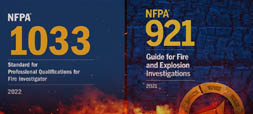
The revision cycle for NFPA 921: Guide for Fire and Explosion Investigation is well underway and an important milestone is coming up. March 5, 2010 is the deadline to comment on the Report on Proposals for changes to NFPA 921 in the 2011 edition. Information on proposed changes and the form to use to submit your comments on these proposed changes can be found at nfpa.org. Participation in this process is open to all members of the public and your comments will be considered by the Committee.

In other news, a new material has been developed to prevent fires in lithium-ion batteries, which are used to power most electronic devices, including laptops and cellular phones. Numerous electronics companies, including Apple and HP, have had to recall products with lithium-ion due to a fire hazard posed by overheating batteries. But now, researchers at the Industrial Technology Research Institute in Taiwan report that they have invented a new technology, called STOBA or S-T-O-B-A that prevents the internal battery shorts that cause fires. STOBA stands for self-terminated oligomers with hyper-branched architecture. STOBA is a nano-grade polymer that sits between the positive and negative half-cells of the battery. When the battery’s temperature reaches 130ºC or encounters external impact or piercing, STOBA transforms from a porous material into a film that “locks” the battery by interrupting the electrochemical reaction. This technology may usher in a new era of fire safety for the over three billion lithium-ion batteries manufactured every year.

Finally, we’ll close with news from the IAAI.

The IAAI Training Summit was held the week of February 8th, 2010 in New Orleans, Louisiana. The group of fire investigation instructors and class developers reviewed the ongoing training program of the IAAI and identified new class subjects and courses to be developed in 2010.

One of the most important innovations to be released in 2010 is the Skill Practicums. The Skill Practicums employ an intense, hands-on demonstration format to give the fire investigator the opportunity to display their skills in evidence gathering, scene evaluation, and scene management. A test will be conducted in the spring and the first practicums are scheduled for the summer of 2010.

IAAI’s Annual Training Conference is coming up May 17 through 21, 2010 in Orlando, FL. One of the highlights of this year’s ATC will be a one week training class which, upon completion, will allow the qualified applicant to meet the training requirements and test for the Fire Investigation Technician professional credential. In next month’s podcast, we’ll have a full preview of ATC 2010. For more information on these and other IAAI professional development opportunities, contact the IAAI office at 1-800-468-IAAI.

That concludes this IAAI CFITrainer.Net podcast. We’ll see you again next month.

CFITrainer Upcoming Programs
Explosion Dynamics
CFITrainer Email Alerts
E-Mail Address:
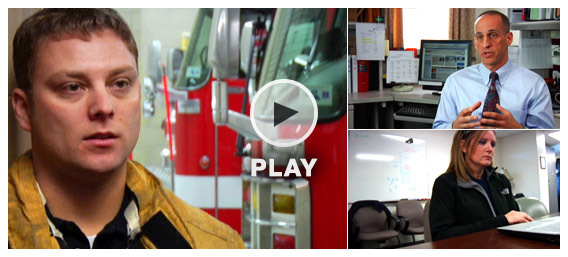
CFITrainer Promo Video
Promo Video
Play Now
CFITrainer Poll
Does your employer support travel for training?


Learn About
Meeting In A Box
Click Here